
The Weird and the Eerie of Matriarchs

A little while ago, I took in some of Nocturne—a long-running annual art festival hosted in the city I live. The festival, dispersed along the city’s downtown and north end, features local and travelling artists who present their art installations, put on performances, and do outreach for various social causes. Though the festival spans a few days, Saturday night is typically the main event, so my partner and I went for an evening jaunt to take in some art.
Though there were many cool and interesting pieces (of note was Spheres, a live-drawing transposed to music), the installation that gripped me the most was undoubtedly Aquakultre’s Matriarchs.
Aquakultre is the moniker of Lance Sampson, a local troubadour and multimedia artist whose mission is to “share his love for his unique and beautiful corner of the diaspora.”
Matriarchs aimed to do just that. The piece took up roughly a third of a basketball court, and was partitioned into four quadrants using black curtains. The ceiling was left open, leaving the nigh full moon looming overhead as we walked through each quadrant, inside of which were recreations of living spaces from Aquakultre’s childhood.
Matriarchs is described by Nocturne as a “collection of living rooms, evoking time spent with The Grandmothers of our families.” The capitalization of “Grandmothers” in this description is pertinant: it denotes a level of deification. Walking through each of the living rooms, I felt Aquakultre’s reverence for these formative figures manifested in each minute detail. The arrangement of the antiques, the lighting, the sound—everything seemed endowed with intention, considered to an intimate degree.
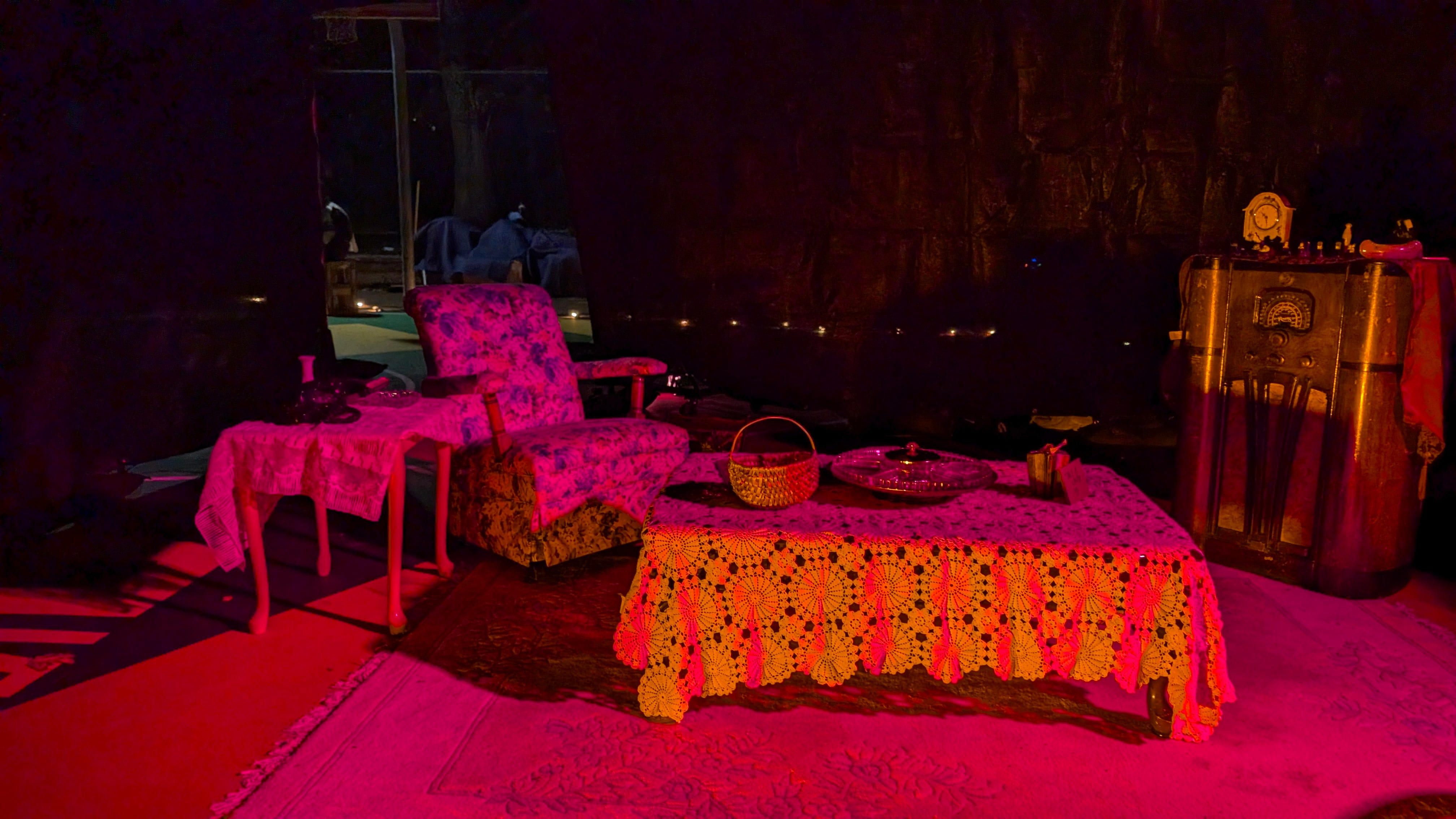
Yet, reading the artist’s own description for his work after having experienced it myself, I’m left a little puzzled. In Aquakultre’s words, Matriarchs is meant to show the living room as “the place where everyone congregates - it's the warmest room in the house - where the grandparents are chillin’, it’s where you’re gonna get told the teachings.”
This idea, of the living room as a beacon of warmth and community, seemed at odds with my experience of the piece. Conversely, the living rooms didn’t feel familiar, or warm: they felt weird and eerie.
The Weird and the Eerie
To be clear, when I describe Matriarchs as “weird and eerie”, I don’t mean so in a pejorative sense. Mark Fisher, in his final published work prior to his death, The Weird and the Eerie, argued that the titular concepts reach beyond our everyday use of them. Typically, when we attribute the weird and the eerie, we generally intend the former to mean off-kilter (bizarre, grotesque, absurd, etc.), and the latter to mean spooky (somewhat scary, macabre, unsettling, etc.). Aliens are weird, dungeons are eerie.
These “modes” (as Fisher refers to them) have been colloquially relegated to adjectives, often prescribed when talking about genres such as sci-fi or horror. The Weird and the Eerie endeavors to analyze the two concepts holistically, and demonstrate that they pertain to far more than zombies and vampires, and are “worth reckoning with in [their] own right as a particular kind of aesthetic experience […] without the need for specific forms of cultural mediation.”
Though the weird and the eerie are both found in horror media, for Fisher, the two aren’t bridged by the horrific, but rather the strange.
The allure that the weird and the eerie possess is not captured by the idea that we “enjoy what scares us”. It has, rather, to do with a fascination for the outside, for that which lies beyond standard perception, cognition and experience.
It’s tempting to equate the strange with the uncanny, but Fisher distinguishes the two by virtue of negation. Whereas the uncanny projects the familiar onto the unfamiliar, the weird and the eerie “make the opposite move: they allow us to see the inside from the perspective of the outside.” This distinction will prove crucial for my analysis of Matriarchs.
The weird, for Fisher, is “that which does not belong”, and the eerie deals with spaces that are “emptied of the human”. To put it another way, the weird is constituted by a “wrongness”, whereas the eerie is when “there is something present where there should be nothing, or there is nothing present when there should be something.” I think both of these modes apply to Matriarchs, and by using them, I will attempt to reckon with, and put into words, my experience of the piece.
The Eerie
I’d like to start with the eerie, because I think it is the simpler of the two to reason through in regards to Matriarchs.
Fisher, describing the eerie, called it “fundamentally tied up with questions of agency. What kind of agent is acting here? Is there an agent at all?”
This was precisely what bothered me about sitting inside the living room recreations. These spaces, which possess so much personality, imply so much life, are bereft of the ones responsible for them.
As I waded through Aquakultre’s curated living rooms, a feeling of trespass pervaded me.
See the inside from the perspective of the outside.
It was as if I was just that: a trespasser, an outsider. Where was this feeling coming from? Why couldn’t I relate to these spaces as the havens of warmth and community they were prefaced to be? It felt as if I had stepped beyond the veil, the instillation becoming a localized purgatory, the memories of these women playing on an endless loop.
Throughout the instillation, soundscapes constantly overlapped, emphasizing the feeling of limbo. Aquakultre’s musical talent was on full display as collages of sounds resounded, creating an infinite recursion: a static-ridden radio, the sounds of cars passing by through an open window, the loud, startling ring of a telephone—all intermittently overlaid with the “recorded voices of the matriarchs of [Aquakultre’s] family — [his] Great Great Grandmother Harriet Carvery, Great Grandmother Daisy Thompson, [his] Grandmother Carolyn Sampson, and [his] mother Meteana Sampson”.
Walking through Matriachs felt a bit invasive, like I was inhabiting someone else's memory; or, rather, like I was a spectator within someone’s mind as they recalled—perhaps dreamed—of their childhood. Remembering is a messy process: some memories shine through brighter than others, and chronologies bend and break, forming contradictions and confusing historicity. When I think of my own childhood, for example, I don’t see it temporally, nor sequentially like a film. Instead, I recall random, seemingly insignificant instants, or flashes of sensations. The feeling of walking around in a puffy snowsuit; the sound of Three Days Grace in my pre-historic MP3 player; a rogue gust of wind that knocked me on my ass one day at recess in elementary school. Often, I’m not even able to recall my childhood at will—usually memories find their way to me unconsciously, prompted by a smell, or an innocuous sensation. “Madeleine moments”, as Proust called them.
Matriarchs seemed to operate on this sort of dream logic. The way Aquakultre centered certain objects—using sensory details to spotlight or to slightly accentuate things—felt akin to how memory tends to hone in on hyper-specific points instead of whole, complete scenes. A deliberate sound breaks through the maelstrom of background noise. Toy army men overturned on an otherwise tidy dresser. The creak of an old rocking chair. It’s here, amongst the idiosyncracies of memory, that I believe the eerie resides.
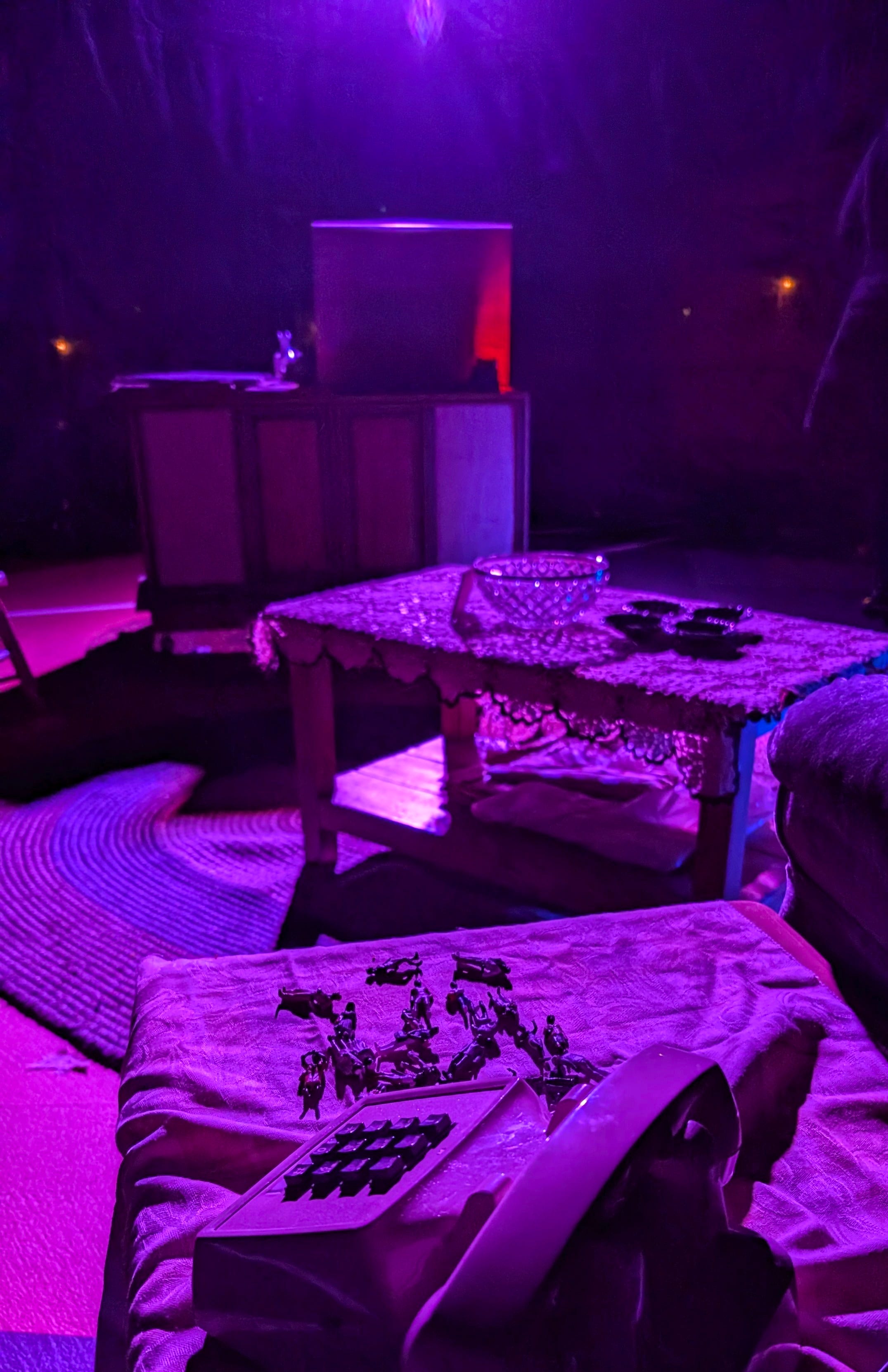
Recall Fisher’s description of the eerie as “something present where there should be nothing, or there is nothing present when there should be something.” There is an implicit empiricism to this definition: There are living rooms inside a basketball court, and they’re missing their matriarchs—therefore, eerie. Though this line of analysis is fairly simplistic, I actually think it does a decent job of explaining my experience of the piece on an aesthetic level. Walking through the piece felt surreal, like an odd dream.
The Weird
The weird is the eerie’s more phenomenological counterpart, making it harder to nail down in such simple terms. But, if Matriarchs is an eerie entity, then my subjective experience—the wrongness I felt—constitutes the weird. I’ll do my best to explain what I mean below.
The distinct sense of haunting throughout Matriarchs lends itself to another of Fisher’s contiguous interests—hauntology.
Hauntology is a convoluted concept (I expound on it more in “The Art of Leisure”) to say the least, but I think Fisher’s interpretation of it is apt:
It doesn’t feel as if the 21st century has started yet. We remain trapped in the 20th century […] in 1981, the 1960s seemed much further away than they do today […] cultural time has folded back on itself, and the impression of linear development has given way to a strange simultaneity.
—Mark Fisher, Ghosts of my Life
For Fisher, hauntology describes lost futures, the specter of the past bleeding through to the present like a palimpsest. It’s not simply about nostalgia, the desire for a past feeling, but the mechanics of history itself—the recursion of ideas, the feedback of culture. Impressions of potentialities—presents that could have been—are felt throughout all aspects of existence, baked into our traditions, our art, our pursuits.
The eponymous women of Matriarchs left not only an indelible mark on Aquakultre, but on the precise space itself, their presence lingering like a phantasm. The basket ball court the installation occupied belongs to a larger space called the George Dixon Center Park, named after the first ever black athlete to win a world championship in any sport, and the first Canadian-born boxing champion. The park rests in the North end of Halifax, adjacent to Uniake square, a public housing project that was constructed in the 60s to house those displaced from Africville, a historic black community Aquakultre has family ties to.
Africville was a community largely comprising African Nova-Scotians, the earliest of whom were brought to Canada as enslaved peoples. African Nova-Scotians were among the founders of Halifax, and many residents of Africville, and Nova Scotia more broadly, can trace their lineage back to the genesis of the city. In the 1960s, after decades of neglect from the city, Africville was demolished under the guise of “urban renewal”, with many of its residents being relocated to Uniake Square, right where Matriarchs took place. The history of Africville and Halifax’s treatment of African Nova-Scotians is baked into Matriarchs both implicitly (in its location and thesis), and explicitly (the monologues playing over the speakers expressing exhaustion at the black voices in the community being ignored).
Fisher adds to his conception of the weird by saying it “brings to the familiar something which ordinarily lies beyond it, and which cannot be reconciled”. This, I think, attributes to my experience of the weird in Matriarchs, and ties into the context above.
As an outsider to both Halifax and the black experience, being privy to Aquakultre’s intimate recollections was honestly a little uncomfortable, but also powerful. I have the privilege of being able to live in the North End, be enriched by its vibrant arts scene, cafés, and restaurants, but doing so inevitably contributes to the gentrification that is driving so many people from the place their families have called home for decades—centuries, even. Squaring those two facts feels like an impossible task. Or, as Fisher put it, a failure of reconciliation.
The Dissolution of the Mundane
Because the eerie entails a detachment from the urgencies of the everyday, (Fisher’s example of this is the expression '“eerie calm”) it gives us “access to the forces which govern mundane reality”. Everyday we are “caught up in the rythms, pulsions and patternings of non-human forces”, and Fisher says the eerie goes some way in revealing this “metaphysical scandal” at play in our lives. This detachment from the mundane precisely describes the feeling that Matriarchs instills: with the living rooms void of those who once called them home, their history, and the lingering presence of unseen forces, take the forefront. To put it more pretentiously: the lacuna of physical agents brings the persistance of metaphysical agents into relief.
Laid out as such, the weird and the eerie sound like the modes of late capitalism writ large. Indeed, Fisher describes capital itself as eerie: “Capital is at every level an eerie entity: conjured out of nothing, capital nevertheless exerts more influence than any allegedly substantial entity.”
It feels discernably, well, weird, going about regular routines—working, getting groceries, exercising—while the world descends into climate catastrophe, corporate hegemony bleeds everyone for all they’re worth, and information on global injustices is easier to access than ever before. It feels as though we are entirely at the mercy of intangible, eerie forces, and although the “metaphysical scandal” of capitalism rears its head more and more, it sometimes feels altogether too late to adequately react.
Yet, this wrongness isn’t a bad thing. In fact, I think it’s the natural result of social and class consciousness—there should be something strange about modern existence, because there is a failure of reconciliation that sits at the basis of it. The greater project of capitalism and its congruous arms—colonialism, imperialism—are built on fundamental antinomies, and the more these contradictions burgeon, the more unsettling it feels to navigate the world as we once did.
A weird entity […] is so strange that it makes us feel that it should not exist, or at least should not exist here. Yet if the entity […] is here, then the categories which we have up until now used to make sense of the world cannot be valid. The weird thing is not wrong, after all: it is our conceptions that must be inadequate.
Living in the North end feels a little weird, just like being a settler in Canada feels a little weird, just like being a modern consumer feels a little weird. And that’s OK—good, even. But the aforementioned feeling of helplessness, that the systems at play are too ancient, too ubiquitous to confront in any meaningful way as an individual, is exactly the type of demoralization that said systems are designed to evoke. Alienation and isolation aren’t just symptoms, they’re intended results.
If we don’t believe in the possibility of a better world, then we’re already doomed. Connection, community—these are the lifeblood of hope. By bridging peoples’ experiences, art like Matriarchs—where subjecthoods are given the space and nuance to clash and interact—facilitates solidarity.
Though the skies are darkening, Matriarchs says, find a neighbor, build a fire, and keep the stories alive.
If you made it this far, thanks for reading! Find me on Bluesky @coleboy.bsky.social : )